

How Carpenter Ants Damage Homes in Western New York
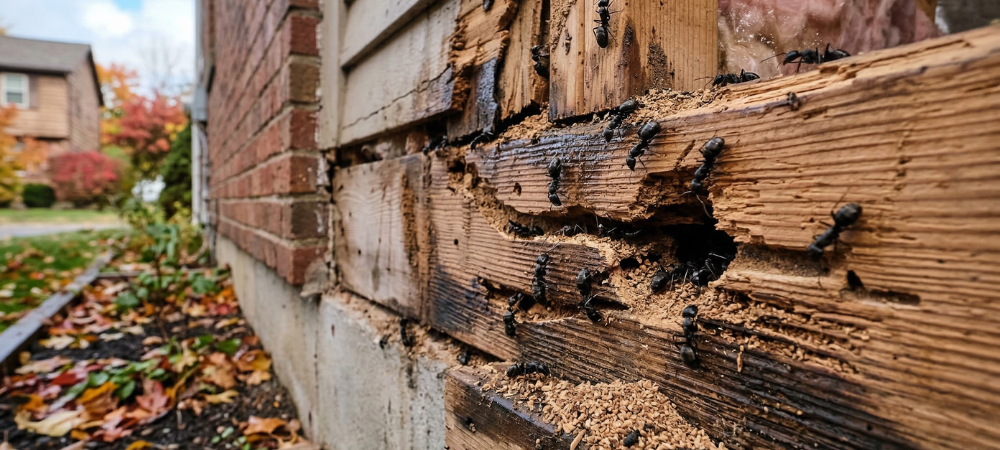
The wood shavings under your windowsill aren't rot. They're frass, and they mean carpenter ants have been at work in your wall for a while. Here's what you need to know.
What You Should Know
- Carpenter ants don't eat wood — they tunnel through it to build nests, and the structural damage they cause accumulates quietly over months and years.
- Western New York's climate, tree cover, and older housing stock make carpenter ant pressure higher here than in many other regions.
- Early detection is key. Most infestations are well-established before homeowners see visible damage.
Carpenter ants are one of the most common pest complaints we handle across Western New York, and one of the most underestimated. Homeowners tend to spot a few large black ants in the kitchen in spring and assume it's a minor nuisance — but by the time those ants are visible indoors, the satellite nest that sent them there has often been active for a year or more. In our 26 years in this region, we've opened wall voids to find galleries that stretched through floor joists, window headers, and basement sill plates with no visible exterior sign.
How Do Carpenter Ants Damage Homes?
Unlike termites, carpenter ants do not consume wood. They excavate it — chewing through wood fibers to create smooth, clean galleries where they nest and raise young. The wood they remove is pushed out as a fine, sawdust-like material called frass, which often collects below infested areas and is one of the clearest early warning signs.
A mature carpenter ant colony can contain several thousand workers. The primary nest is almost always located outdoors — in a dead tree, stump, or rotting log. When that outdoor colony grows large enough, workers establish satellite nests inside structures, often connected to moisture-damaged or softened wood. According to the University of Wisconsin Extension, satellite nests inside homes don't require the moisture that primary nests do — they can exist in sound, dry wood once workers have moved in.
Over time, the tunneling weakens structural lumber from the inside. Floor joists, window framing, porch columns, and roof sheathing are all common targets. Because the outer surface of damaged wood often remains intact, homeowners may not realize the extent of the problem until they press on a soft spot and it gives way.
Why Are Carpenter Ants Such a Common Problem in Western New York?
Western New York is genuinely favorable territory for carpenter ants. A few regional factors drive this:
- Tree density: The Buffalo metro area has a high concentration of mature trees. Dead or declining branches, stumps, and logs provide abundant outdoor nesting sites close to residential structures.
- Older housing stock: Many WNY homes were built in the mid-20th century or earlier, with wood-framed construction that may have accumulated moisture damage in sills, headers, and rim joists over decades.
- Moisture issues: Western New York's winter precipitation, freeze-thaw cycles, and lake-effect snow create persistent moisture exposure around foundations, fascia, and exterior trim — exactly where carpenter ants prefer to start.
- Firewood storage: Wood stored near or against the house is one of the most common pathways for carpenter ants to transition from an outdoor colony to a satellite nest inside the structure.
Common Nesting Areas Inside Homes
Understanding the signs of carpenter ants in your home starts with knowing where they nest. Inside structures, satellite nests are typically found in areas with past or current moisture exposure:
- Basement sill plates and rim joists (especially on north-facing sides)
- Around leaky pipes or plumbing penetrations
- Window and door frames, particularly on older or wood-framed windows
- Roof sheathing near flashing or gutters with drainage issues
- Porch ceilings and columns with wood-to-soil contact
- Hollow interior doors (a frequently overlooked nesting site)
Warning Signs of a Carpenter Ant Problem
Catch an infestation early and treatment is straightforward. Let it go unaddressed and you're looking at structural repairs on top of pest control. Watch for these indicators:
- Frass: Fine, sawdust-like material, sometimes mixed with insect body parts, accumulating below walls, near window frames, or in basement corners
- Large black ants indoors in spring: Seeing individual carpenter ants — especially workers 1/2" or longer — inside the house, particularly at night
- Winged ants (swarmers): The presence of winged reproductives inside in spring signals a mature, well-established colony nearby
- Rustling sounds in walls: Faint crackling or rustling from inside walls, especially at night, can indicate active gallery construction
- Soft or hollow-sounding wood: Probing suspected areas with a screwdriver and finding soft spots or hollow sounds in structural lumber
- Ant trails: Regular trails of workers moving between the outdoors and a specific point of entry on the home
Knowing which species of ant you're dealing with matters because treatment approaches differ. Carpenter ants require tracking the trail back to the nest — baiting methods that work for odorous house ants or pavement ants are often ineffective against carpenter ants.
What Attracts Carpenter Ants to Your Home?
Beyond moisture-damaged wood, several conditions make a home more attractive to carpenter ant establishment:
- Firewood stored against the foundation or within a few feet of the structure
- Dead trees, stumps, or large limbs within 50 feet of the house
- Vegetation or mulch in direct contact with exterior siding
- Food sources inside (particularly proteins and sweets accessible on counters or in open containers)
- Gaps around utility penetrations that allow worker access from outdoor colonies
Removing or reducing these conditions doesn't eliminate an existing infestation, but it significantly reduces reinfestation risk after treatment.
Can You Get Rid of Carpenter Ants Without Professional Help?
For a minor surface incursion with a clear, accessible trail, some homeowners have success with targeted perimeter sprays and eliminating attractants. The challenge with carpenter ants — and what makes them different from most household ant species — is that the problem is almost always bigger than what's visible. Treating the ants you see doesn't reach the satellite nest in the wall. And without locating the primary outdoor colony, you may see the same problem recur season after season.
You and I both know that DIY pest control has its limits. When structural wood is involved, finding and treating the source the first time is worth it. If you're noticing any of the signs above — particularly frass or swarmers — it's worth getting a professional set of eyes on the situation before assuming it's minor.
Professional Carpenter Ant Control in Western New York
At Eco Serve Pest Services, our approach to carpenter ant control starts with a thorough interior and exterior inspection to identify satellite nests, primary colony locations, and the entry points workers are using. Treatment targets the source — not just the ants you can see. We also look for the moisture and structural conditions that are supporting the infestation and recommend corrections that reduce future pressure.
Our residential pest control programs cover carpenter ants with free retreatment within the guarantee period if activity continues. For homeowners who've also had issues with ants showing up in the kitchen or other pests entering through the same structural gaps, a comprehensive program addresses multiple entry points at once.
Don't let a structural pest problem get ahead of you. Contact Eco Serve Pest Services today for a free inspection, and we'll tell you exactly what you're dealing with and what it takes to fix it for good.