

Carpenter Ants & Spiders in Western NY: How to Tell Them Apart and Keep Them Out
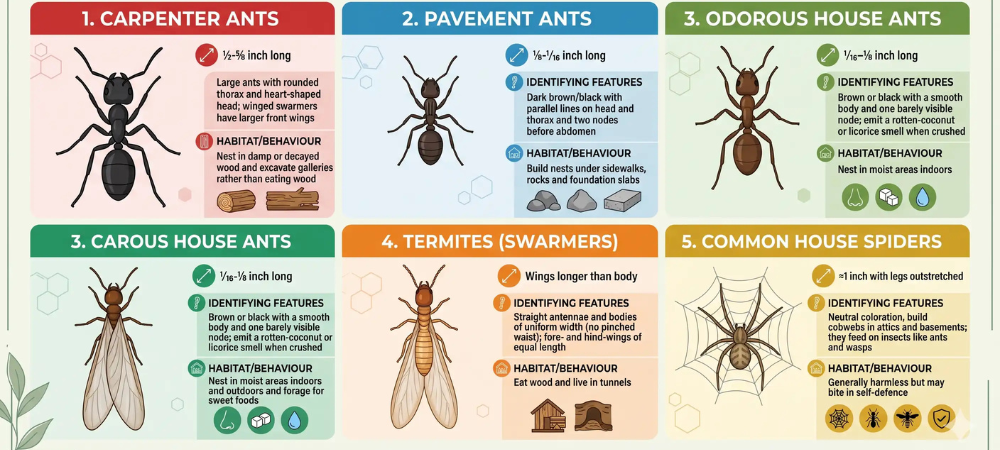
Carpenter Ants, Pavement Ants & Spiders: A Western New York Homeowner's Guide
Bottom Line Up Front
Carpenter ants are large, wood-excavating ants that wake up in early spring and can cause structural damage to homes. They are often mistaken for pavement ants, odorous house ants or even termites, but knowing the differences helps you choose the right treatment. Western New York homeowners also see an uptick in spiders when insects reappear. This guide explains how to recognize each pest and offers prevention tips so you can protect your family and property.
Identifying Carpenter Ants
Appearance and Size
Carpenter ants are among the largest ants homeowners encounter. Workers vary in size from about ½ to ⅝ inch (12–16 mm) long. While many species are black, some may be reddish, yellowish or bi-colored. Unlike smaller nuisance ants, carpenter ants have a smoothly rounded thorax and a heart-shaped head. Winged reproductives (swarmers) appear in spring and fall; their front wings are longer than the hind wings.
Behaviour, Nests and Damage
Carpenter ants do not eat wood — they excavate moist or decayed wood to make galleries. Because Western NY has abundant trees and firewood, these ants often nest outdoors in stumps, logs or tree roots and send workers into homes to establish satellite nests. Signs of an infestation include:
- Frass: sawdust-like material near window sills, door frames or the sill plate.
- Noise in walls: faint rustling from ants chewing through wood.
- Winged ants indoors: discarded wings indicate that reproductive ants have emerged and are establishing new colonies.
Carpenter ants are most active in early spring when they wake from dormancy and forage for food and water. Repeated sightings inside during warm months suggest a nest in wall voids that may lead to structural damage.
Pavement Ants vs. Odorous House Ants
Pavement Ants
Pavement ants are tiny (approximately ⅛–¹⁄₁₆ inch long) and dark brown to black. Workers have parallel grooves on the head and thorax and two small nodes between the thorax and abdomen. These ants build nests in cracks of sidewalks, under rocks or along foundations. Indoors they may nest under floorboards or carpets and feed on sweets, grease and dead insects. When crushed they emit a slight acid odor, but not the strong coconut smell associated with odorous house ants.
Odorous House Ants
Odorous house ants (Tapinoma sessile) are similarly small (¹⁄₁₆–⅛ inch long) but have a single, barely visible node connecting the thorax and abdomen. Their bodies are smooth and brown or black, and they release a rotten-coconut or licorice scent when crushed. These ants nest in moist locations such as mulch, beneath stones and inside wall voids. Odorous house ants are omnivorous but have a particular liking for sugary foods.
Are They Dangerous?
Pavement ants are generally considered nuisance pests; their stings are too weak to pierce human skin. Odorous house ants do not damage wood but can contaminate food when they invade kitchens. In contrast, carpenter ants can weaken structural lumber by hollowing it out. Correct identification is essential because control strategies vary by species.
Carpenter Ants vs. Termites
Winged carpenter ants are often mistaken for termites. You can distinguish them by looking at antennae, wing length and body shape:
- Antennae: ants have elbowed antennae, whereas termites have straight antennae.
- Wings: termite swarmers have four wings of equal length that are much longer than their body. Carpenter ant swarmers have larger forewings and smaller hind wings.
- Waist: ants have a narrow, pinched waist; termites have a uniformly wide body.
Both insects are social and attracted to moisture, but their feeding behaviour differs: carpenter ants excavate wood to create galleries, leaving smooth tunnels, while termites eat the cellulose in wood. Termites are relatively uncommon in Western NY; however, occasional infestations do occur and should be addressed by a professional.
Common Spiders in Western New York Homes
As insects reappear in spring, spiders become more noticeable indoors because they follow their prey. Common species include:
- Common (American) house spider — about an inch long with legs outstretched; builds cobwebs in attics, basements and sheds. Feeds on insects; may bite if provoked. The venomous black widow is a cobweb spider but extremely rare in New York.
- Wolf spiders — large, furry spiders reaching about 2 inches with eight eyes. They roam basements, sheds and garages hunting insects. May bite when threatened, causing itchy red bumps.
- Sac spiders — yellowish spiders with darker leg tips, up to ½ inch. Found near baseboards, ceilings, windows and doors. Their bite produces an immediate sting and a slow-healing sore.
- Jumping spiders — small, stocky spiders with large eyes; can leap long distances to catch prey. Usually found on windowsills and mailboxes; generally harmless but will bite if handled.
- Daddy long legs (harvestmen) — not true spiders; single body segment; can reach about 2 inches across. Prefer humid areas like basements and crawl spaces; considered harmless.
Prevention Tips for Ants and Spiders
Adopting good sanitation and maintenance practices is the best way to deter pests. The following steps reduce the likelihood of ant and spider infestations:
- Eliminate moisture: fix plumbing leaks and divert downspouts away from your foundation. Both carpenter ants and termites are attracted to damp wood.
- Seal entry points: caulk cracks and gaps around windows, doors and the foundation. Repair torn screens and replace weatherstripping.
- Properly store wood: keep firewood elevated and away from your home. Discard rotten wood to remove nesting sites.
- Keep food sealed: store pantry goods in airtight containers and clean up crumbs and spills promptly. Take out garbage regularly.
- Reduce clutter: clear out piles of boxes, papers or yard debris that provide hiding places for pests.
- Control other insects: spiders feed on bugs. Reducing ant, fly and mosquito populations lowers spider activity.
If you suspect a carpenter ant nest inside your walls or see large numbers of spiders despite prevention efforts, contact a professional pest control service. DIY sprays or bait may not reach satellite nests, and controlling large colonies requires expert knowledge.
Frequently Asked Questions
Need Help? We’re Here for You
At Eco Serve Pest Services we understand how stressful a pest problem can be for your family. Our local, woman‑owned team has been protecting Western New York homes for more than 26 years. Whether you’re dealing with carpenter ants, pavement ants, odorous house ants, spiders or another pest, our friendly technicians can inspect your property, identify the intruders and recommend an eco‑friendly solution. Call us today at 716‑293‑2500 for a free quote, and let’s keep your home pest‑free all year long.