

House Mouse vs. White-Footed Mouse
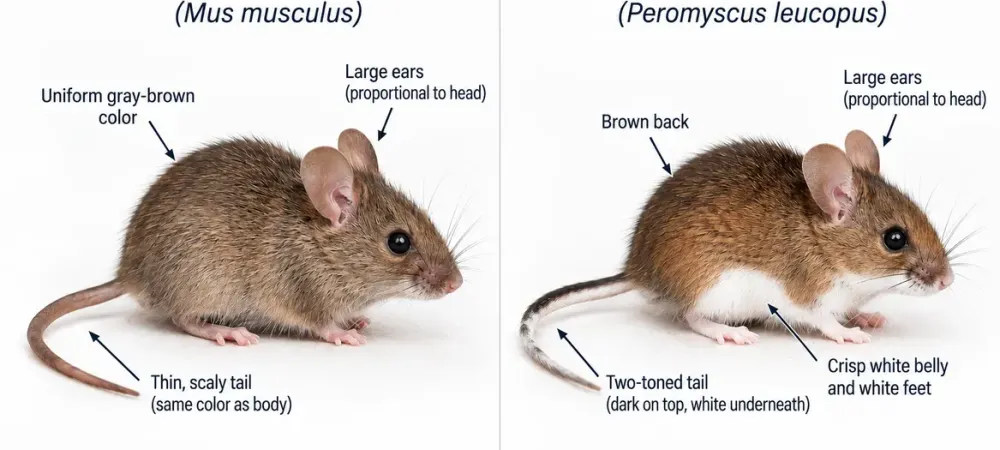
House mice and white-footed mice are both found in New York, and both can turn up inside Western New York buildings. The easiest visual clue is contrast: a house mouse is usually more uniformly gray-brown, while a white-footed mouse typically has a brown to reddish-brown back, bright white underside and feet, and a distinctly two-toned tail. Behavior also matters. House mice are strongly associated with buildings and can live indoors year-round, while white-footed mice spend most of their lives outdoors and are more likely to enter structures from fall through spring. Accurate identification helps you understand where the mice may be coming from and what needs to be corrected.
- House mouse (Mus musculus): usually gray-brown overall, with less contrast between the back and belly and a semi-naked-looking tail.
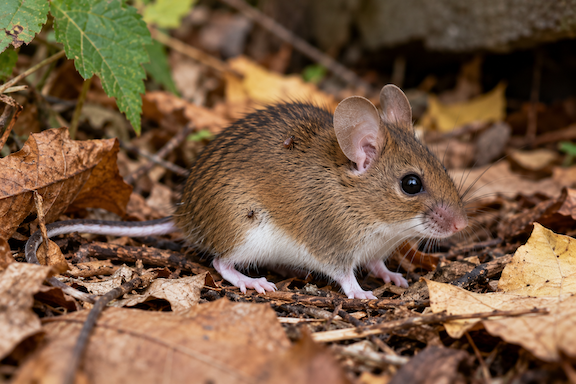
- White-footed mouse (Peromyscus leucopus): brown or reddish-brown above, white below, white feet, and a bicolored tail.
- White-footed mice are primarily outdoor mice. Finding one indoors often points to an exterior opening that allowed it into the structure.
- House mice are well adapted to indoor living and may establish nests close to food, warmth, and hidden wall or storage spaces.
- Droppings alone usually cannot confirm which mouse species is present. Use appearance, location, season, and entry-point evidence together.
- Rodent waste should be cleaned carefully. CDC guidance says not to sweep or vacuum dry droppings, urine, or nesting material.
Two Small Mice, Two Different Patterns Around WNY Homes
You hear scratching near the basement ceiling, find a few small droppings behind stored boxes, and then catch a quick glimpse of a mouse. Was it the familiar house mouse, or a white-footed mouse that came in from outdoors? In Buffalo and Western New York, either is possible. Cornell Integrated Pest Management lists house mice, white-footed mice, deer mice, and Norway rats among the common rodent pests in New York.
This guide focuses on the two mice homeowners may confuse most easily: the house mouse and the white-footed mouse. If you are already seeing signs such as droppings, gnawing, or scratching, Eco Serve’s guide to mice control in Buffalo and Western New York explains the broader signs, entry points, prevention steps, and control options.
House Mouse vs. White-Footed Mouse: Quick Identification Chart
| Feature | House mouse | White-footed mouse | Why it helps |
|---|---|---|---|
| Scientific name | Mus musculus | Peromyscus leucopus | Confirms they are different genera and species. |
| Overall color | Usually fairly uniform gray-brown; belly is similar or only somewhat lighter | Brown, reddish-brown, or grayish above with a clearly white belly | Strong back-to-belly contrast favors white-footed mouse. |
| Feet | Not strikingly white | Distinctly white | A useful visual clue when the feet are visible. |
| Tail | Semi-naked appearance; usually similar in tone overall | Furrier-looking and distinctly bicolored, darker above and lighter below | Tail pattern can be one of the best clues. |
| Typical relationship to buildings | Can live and reproduce indoors year-round | Primarily outdoors; enters structures, especially fall through spring | Helps interpret where the mouse may be originating. |
| Indoor clue | Activity may persist regardless of season if food and shelter are available | Indoor appearance often suggests an exterior access point | Guides inspection and exclusion priorities. |
What Does a House Mouse Look Like?
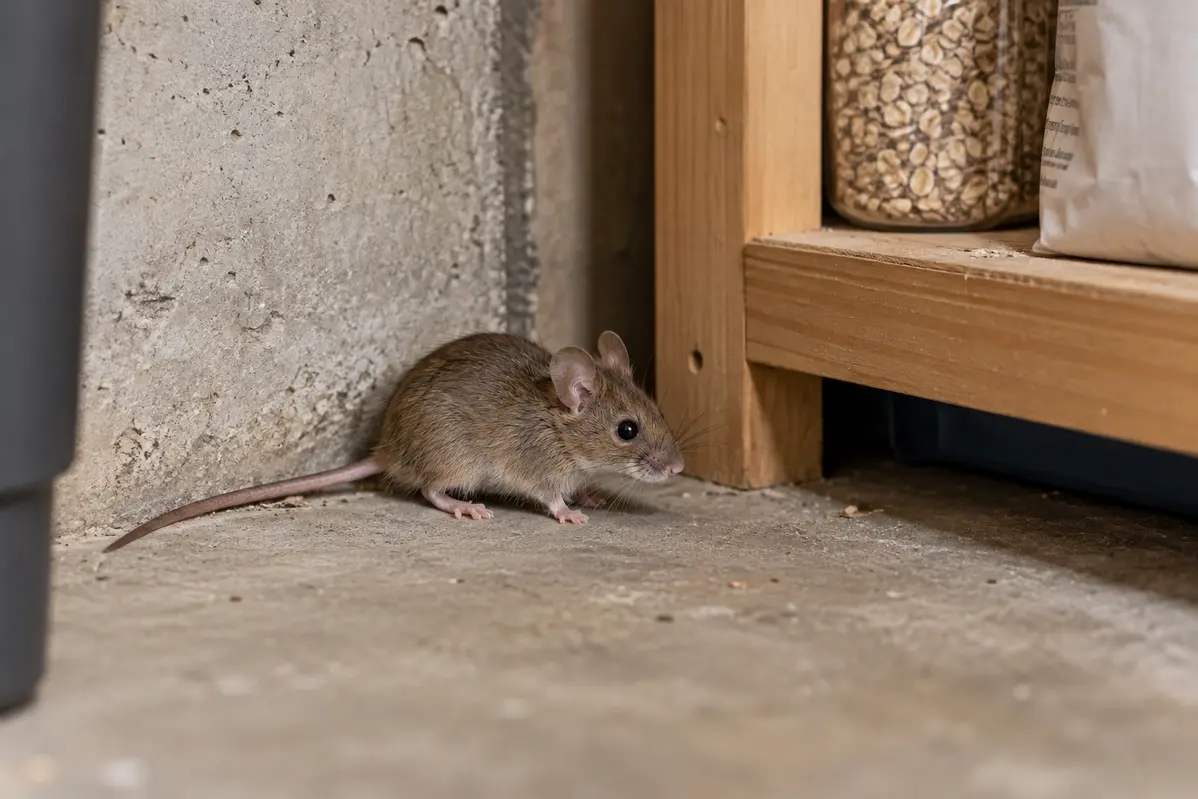
The house mouse is the classic indoor mouse. Cornell IPM describes adults as about 2.5 to 3.75 inches long in the body, with a tail about 2.75 to 4 inches long. They have relatively large ears and eyes, a pointed nose, and a semi-naked tail. The fur is typically grayish-brown, and the back and belly are more uniformly colored than in white-footed or deer mice.
That more even coloring is important. A house mouse may have a somewhat lighter underside, but it usually lacks the crisp white belly and white feet that make a white-footed mouse look almost two-toned. House mice are also closely tied to human structures. They can live outdoors when conditions are suitable, but they are capable of spending their entire lives inside buildings.
What Does a White-Footed Mouse Look Like?
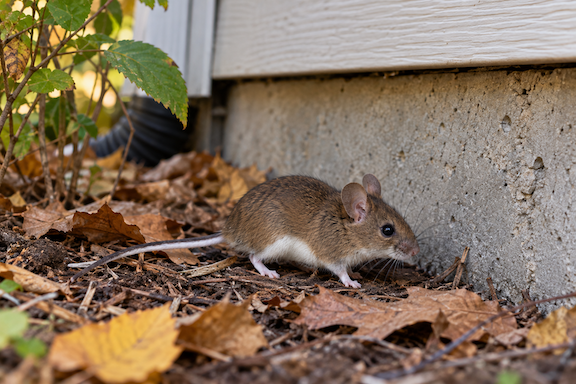
The white-footed mouse is similar in overall size and shape to a house mouse, but its color pattern is usually more distinctive. Look for a brown, reddish-brown, or grayish back paired with a white belly and clearly white feet. The tail is typically bicolored, darker on top and lighter underneath.
White-footed mice are closely related to deer mice, and those two Peromyscus species can be difficult to distinguish from one another without close inspection. For a homeowner, that means a mouse with a strongly white underside and white feet may be identifiable as a Peromyscus-type mouse more confidently than it can be separated into white-footed mouse versus deer mouse from a quick sighting.
Cornell IPM notes that white-footed and deer mice spend most of their time outdoors but can enter structures from fall through spring. That seasonal pattern makes them especially relevant when cooler Western New York nights arrive and a mouse suddenly appears in a basement, garage, attic, shed, or other structure.
The Biggest Differences to Look For
1. Check the belly and feet
If you get a clear view, color contrast is one of the most practical clues. A white-footed mouse has a noticeably white underside and white feet. A house mouse tends to look more uniformly gray-brown from the back down toward the belly.
2. Look at the tail
A house mouse has a relatively bare-looking, scaly tail. A white-footed mouse usually has a more visibly two-toned tail, with a darker upper surface and lighter underside. Do not rely on tail color from a blurry nighttime sighting, but it can be very helpful in a clear photo or captured specimen.
3. Consider where and when you found it
Location and season add context. A mouse living deep inside a heated building with repeated pantry or wall-void activity may fit the house mouse pattern. A white-bellied mouse that appears in a garage, basement, shed, or attic during fall or winter may have entered from nearby outdoor habitat. Eco Serve’s article on why mice and rats move indoors when temperatures drop explains how seasonal shelter, food, and building access come together in WNY.
4. Do not identify the species from droppings alone
Mouse droppings can tell you that rodent activity is present, but droppings from similarly sized mice overlap enough that they are not a dependable stand-alone way to separate a house mouse from a white-footed mouse. A better identification uses multiple clues: the animal’s coloring, tail, where the evidence is concentrated, the season, and whether exterior openings are present.
Why White-Footed Mice Come Indoors in Western New York
White-footed mice are associated with wooded, brushy, and edge habitats, so properties near tree lines, overgrown edges, gardens, sheds, woodpiles, and leaf litter may provide suitable outdoor cover. As fall progresses, buildings can offer protected spaces that are warmer and drier than exposed outdoor sites.
For white-footed mice, an indoor sighting is especially useful as an inspection clue. Cornell IPM notes that finding white-footed or deer mice indoors indicates that an opening is being used to enter the structure. That shifts the question from only “How do I catch this mouse?” to “Where is it getting in?”
Why House Mice Can Become a Year-Round Indoor Problem
House mice are unusually well adapted to living alongside people. Once they have food, water, nesting material, and hidden travel routes, they do not need to return outdoors on a regular schedule. That is why house mouse activity can continue through winter and may persist into spring or summer if the underlying access and indoor conditions are not corrected.
Common evidence includes droppings in cabinets or storage areas, gnawing on food packaging, shredded nesting material, and scratching or movement in walls or ceilings. For a fuller checklist, see Eco Serve’s mice identification and prevention guide and frequently asked questions about mice.
Do House Mice and White-Footed Mice Create the Same Concerns?
There is overlap. Any mouse inside a home can contaminate food or surfaces with urine and droppings, damage stored materials, and gnaw on building materials. The species difference matters most for understanding behavior, likely entry routes, and the surrounding ecology.
White-Footed Mice and Ticks
White-footed mice also play an important ecological role in the Lyme disease cycle in the Northeast. Cornell sources identify the white-footed mouse as an important reservoir host for the bacterium that causes Lyme disease. Blacklegged ticks can acquire the bacterium while feeding on infected reservoir hosts and later transmit it during subsequent feeding. This does not mean that seeing a white-footed mouse in your home means you have Lyme disease. It means the species is relevant to local tick ecology, especially around wooded and brushy habitat.
How to Handle Mouse Droppings Safely
Regardless of which mouse species left the evidence, cleanup should avoid stirring contaminated material into the air. The CDC advises against sweeping or vacuuming dry rodent urine, droppings, or nesting materials.
Instead, wear rubber or plastic gloves, thoroughly wet the material with a household disinfectant or properly prepared bleach solution, allow the required contact time, then wipe it up with paper towels and disinfect the surrounding hard surfaces. Follow the product label and CDC guidance for the space you are cleaning.

What to Do If You Find a Mouse in Your Buffalo or WNY Home
- Look for additional evidence. Check along walls, behind appliances, inside cabinets, near stored food, in basements, garages, attics, and around utility areas.
- Photograph the mouse if you can do so without approaching or handling it. A clear side view showing the belly, feet, and tail can make identification easier.
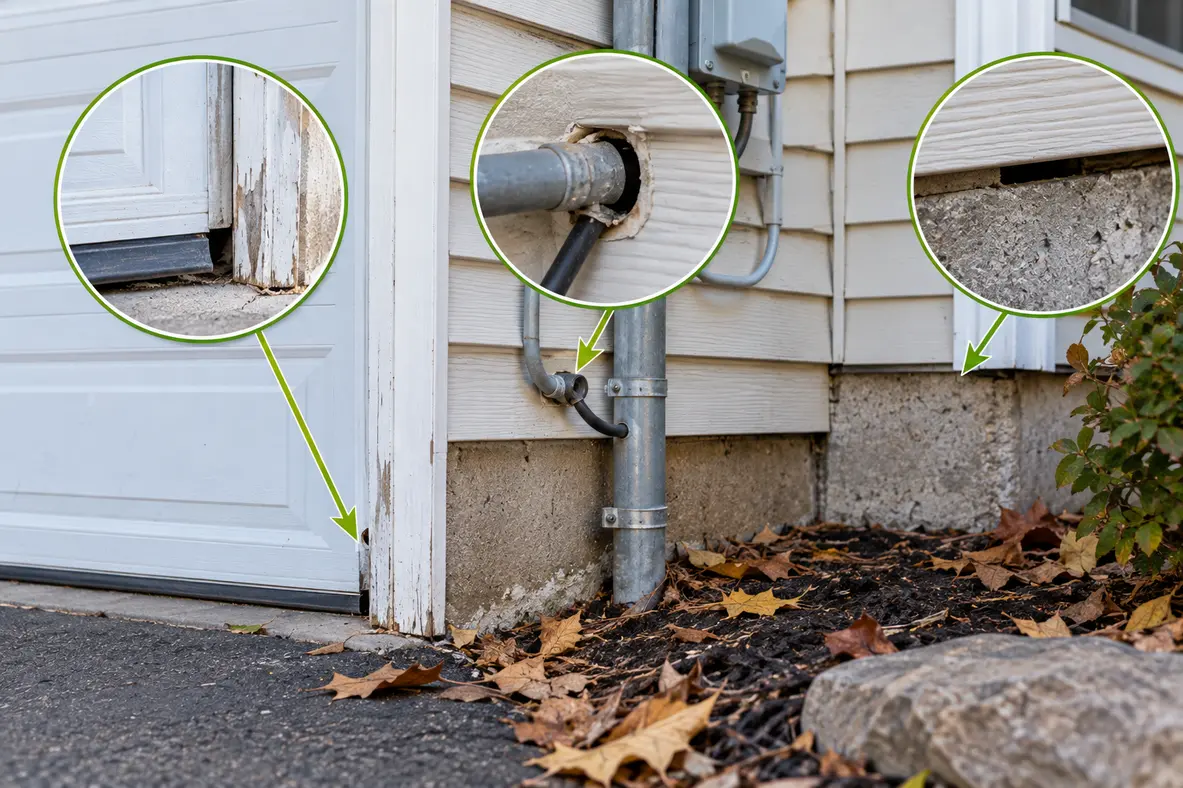
- Inspect the exterior. Pay attention to door sweeps, garage-door corners, foundation transitions, utility penetrations, vents, siding gaps, and other small openings.
- Reduce food access. Store pantry foods, pet food, bird seed, and similar items in sturdy sealed containers and clean up spills promptly.
- Address clutter and nesting cover. Cardboard, paper, fabric, and undisturbed storage can provide protected nesting material and hiding places.
- Use safe cleanup practices for droppings and nesting material. Do not sweep or vacuum contaminated material while it is dry.
If activity continues, the next step is a thorough inspection rather than guessing at the species from one clue. Eco Serve Pest Services provides rodent control in Western New York that focuses on identifying activity, locating entry points, and building a prevention strategy around the property.
Prevention: Keep Both Types of Mice From Getting Comfortable
The prevention basics overlap even though the two mice use buildings differently. The CDC recommends reducing rodent access to food, water, and shelter and sealing openings that allow rodents into structures. Around WNY homes, that means combining indoor sanitation with exterior exclusion.
- Check weatherstripping and door sweeps, especially at garage doors and side entrances.
- Seal gaps around plumbing, electrical, cable, and HVAC penetrations with rodent-resistant materials appropriate for the opening.
- Repair damaged vents, screens, siding transitions, and foundation gaps.
- Keep food, pet food, and bird seed in sealed containers.
- Reduce clutter in basements, garages, attics, and storage rooms.
- Trim dense vegetation away from the structure and manage leaf litter or debris where it creates protected cover near the foundation.
- Inspect seasonally, especially before and during the fall temperature shift.
Homeowners who want help identifying access points can learn more about Eco Serve’s professional rodent control services and broader residential pest control options.
When Identification Is Not Obvious
Not every mouse will cooperate with a clean side-by-side comparison. Lighting changes fur color, young mice can look different from adults, and white-footed mice can be confused with deer mice. If you only saw a fast-moving mouse for a second, it is reasonable to leave the species as “mouse” until stronger evidence is available.
For control, the most useful question is often not simply which species you saw, but whether the mice are established indoors, entering seasonally from outside, or both. A property inspection can connect the evidence to entry points, nesting areas, food sources, and travel routes.
House Mouse or White-Footed Mouse? The Identification Clues That Matter Most
For Buffalo and Western New York homeowners, the clearest distinction is usually appearance plus behavior. A house mouse tends to be more uniformly gray-brown and is highly adapted to indoor life. A white-footed mouse has stronger brown-and-white contrast, white feet, and a bicolored tail, and it normally lives outdoors before entering a structure.
Whichever mouse you find, repeated sightings, fresh droppings, gnawing, or new evidence after cleanup are signs that the problem deserves closer attention. Eco Serve can help identify the activity, inspect likely entry points, and recommend a rodent control approach for your Western New York property. Contact Eco Serve Pest Services to request help with recurring mouse activity.
Frequently Asked Questions
Are white-footed mice common in New York?
Yes. Cornell IPM includes white-footed mice among the common pest rodents found in New York. They are primarily outdoor mice but may enter buildings, particularly from fall through spring.
How can I tell a house mouse from a white-footed mouse?
Look for several clues together. House mice are generally more uniformly gray-brown. White-footed mice usually have a brown or reddish-brown back, white belly and feet, and a bicolored tail.
Is a white-footed mouse the same as a deer mouse?
No. They are closely related Peromyscus species and can look very similar. A quick homeowner sighting may not be enough to reliably separate them.
Do white-footed mice live in houses year-round?
They are primarily outdoor mice. Cornell IPM notes that white-footed and deer mice enter structures from fall through spring. A house mouse, by contrast, can successfully live its entire life indoors.
Can mouse droppings tell me which species I have?
Not reliably by themselves. Dropping size and shape can overlap among similarly sized mice. Use droppings to locate activity, then combine that evidence with appearance, season, location, and entry-point clues.
Should I vacuum mouse droppings?
Not while they are dry. CDC guidance says not to sweep or vacuum dry rodent urine, droppings, or nesting materials because contaminated particles can become airborne. Wet the material thoroughly with disinfectant and follow CDC cleanup steps.
Who can help with mice in Buffalo and Western New York?
Eco Serve Pest Services provides rodent control for Western New York homes and businesses, including inspection, control, exclusion, and prevention-focused service based on the property.